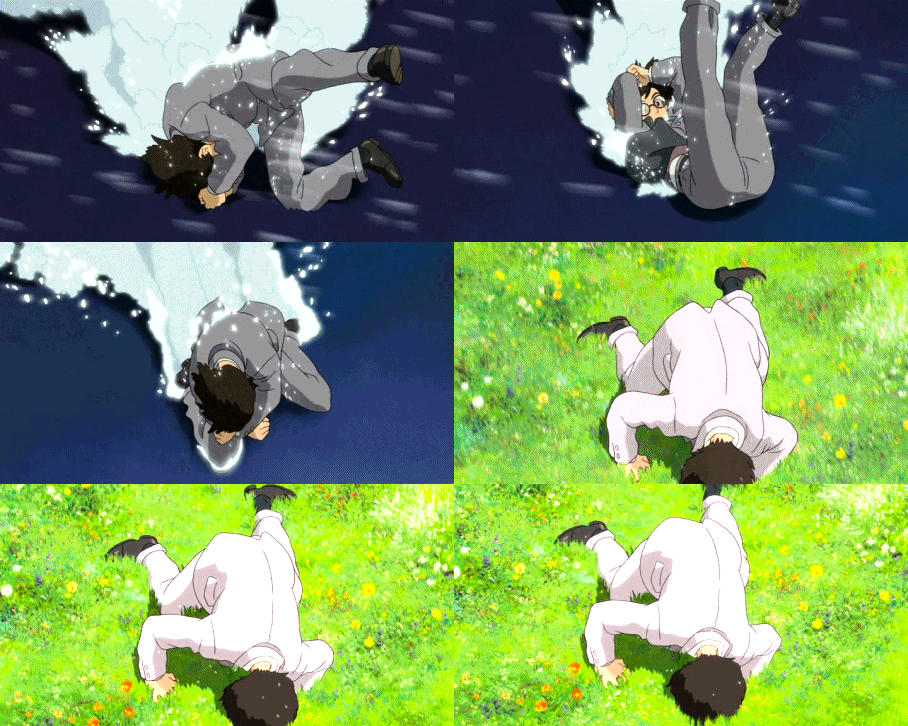
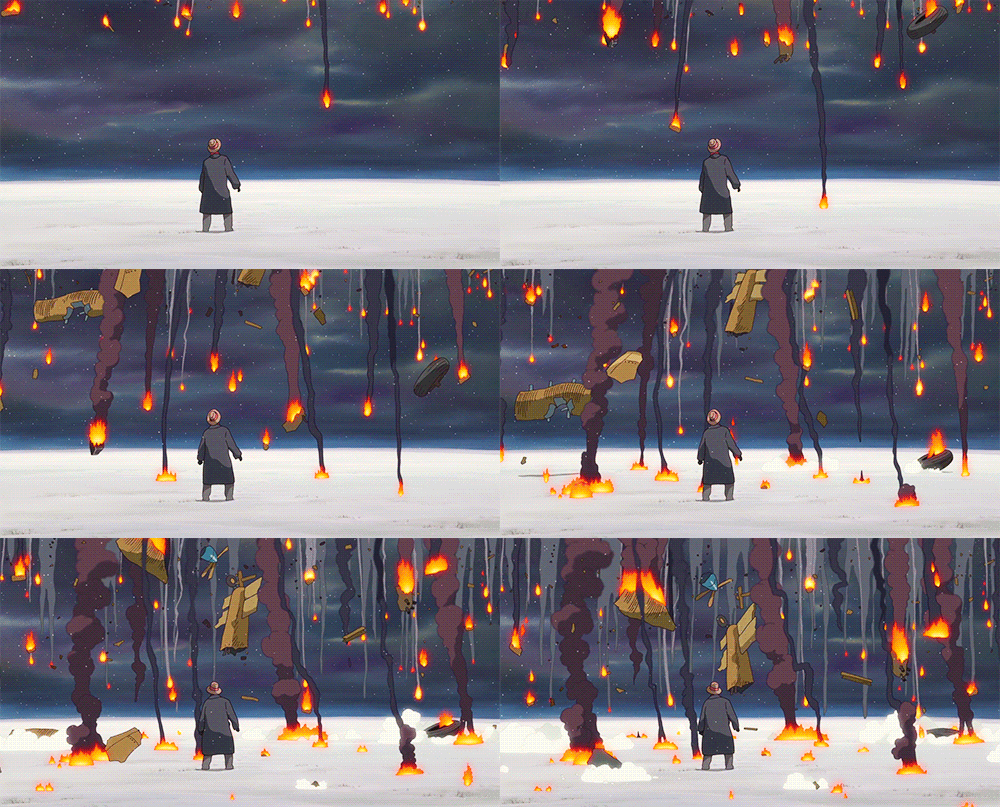
"All I wanted was to make something beautiful."
I
LOVED THIS FILM . Some time had to pass before I could gather my
thoughts on it and write down my reaction, for first I had to let the beauty
sink in, it had left me dazed. Finally, the time has come to WRITE MY REVIEW!
I
first want to talk about how some of the typical elements that are “trademarks”
of Miyazaki’s style are present:
It’s
ENGAGING: Like all of his other movies (I especially noticed it in his most
recent films), The Wind Rises has a great atmosphere/mood/ “ambientación” that pulls you into the world
and story…you actually want to understand what’s going on, almost like if there
were a dialogue between the screen and the spectator. A factor that greatly
contributes to this is the pacing of events…gives kind of a convincing,
realistic feel to the storytelling (of which Miyazaki-san is a great
master). These aspects also cause you to have a GREAT time with
friends and family while watching, since there’s space for commenting on what’s
going on without getting lost or ruining the mood of the film. One particular example of this in The Wind
Rises is how the extras tend to be very peculiar in character design, like, some are fat, others have teeth sticking out from their mouths,
etc. and I was all, “omg, what’s with the people in the background?” Finally,
Miyazaki’s humor, a quiet and human one, quite heartwarming, gives a final
contribution to the “aura” of the movie: this can be found in characters,
especially in those of frank and sarcastic Honjo, bossy and energetic Mr.
Kurokawa, and Jiro’s responsible, scolding, down-to-Earth younger sister, Kayo.
The humor also lies in unexpected funny sequences or events that lighten the
somberness of the movie.
BEAUTIFUL ANIMATION: Miya-san’s
characters tend to have very human-like movements, like, they interact with
their surroundings just like one would in real life. A famous example for this
is when Chihiro puts on her shoes in Spirited
Away. Instead of just animating her feet getting on the sneakers and
walking off, he recreates how a real child might do it: wiggling his feet and
tapping them to make sure they are snug inside. In The Wind Rises, there was this one
sequence where Jiro was at his desk, I think he was straightening the paper he
was working on and then rummaging around his stuff looking for a ruler or
something.


I found it so smooth and delightful to watch….it’s interesting how
such a small ordinary sequence could make any impact. However,
I found some scenes kind of lacking, sometimes the characters looked a little
awkward and there wasn’t as much visual richness as in The Secret World of Arrietty and From Up On Poppy Hill, its predecessors. But I really didn’t mind
this, having read that the director had been too exhausted to make sure all of
the scenes were turning out exactly as he wanted, which is one of the reasons
why he had decided this would be his last film. Anyway, I think anything
lacking in image was perfectly balanced with the heart and powerful content of
the movie.


The
guys at Studio Ghibli are also great magicians with their breathtaking
backgrounds. They’ve only improved more and more in visual quality,
surely thanks to technical advances. One detail that I found very impressive was
a close up on a small cascade of water…this is 2D animation, guys, and yet you
can almost feel the texture of the water (of course, they’ve integrated
CG effects for that, but it still awed me).
 FEMINISM: I find funny how Miyazaki managed to squeeze in his feminist ideals even in this movie, whose focus is a guy's pursuit of his professional dreams, set in 1920s Japan, where men dominated in professional fields. He did it mainly in the figure of Kayo Horikoshi, Jiro’s sister: she is very responsible, has
great attitude, kinda pesky as she’s always finding something to criticize in
her big brother. Her dream is to study medicine,
and she voices her frustration that she can’t achieve it as easily as men due to society's standards for women.
FEMINISM: I find funny how Miyazaki managed to squeeze in his feminist ideals even in this movie, whose focus is a guy's pursuit of his professional dreams, set in 1920s Japan, where men dominated in professional fields. He did it mainly in the figure of Kayo Horikoshi, Jiro’s sister: she is very responsible, has
great attitude, kinda pesky as she’s always finding something to criticize in
her big brother. Her dream is to study medicine,
and she voices her frustration that she can’t achieve it as easily as men due to society's standards for women.
 FLIGHT:
Miyazaki’s obsessed with aircraft, and thus anything else that has to do with
flight. Just like feminism, this theme can never be left out of his creations.
It’s pretty moving that he chose to focus on it in his last film: he wants to
talk about what he loves most. He wants to share with the world why he believes
planes are so beautiful. He had already dedicated his film Porco Rosso directly to this concept, but in this one, it is almost the
protagonist. I found this interesting in which instead of developing a concept
that would be more convenient economically, he decides to focus on what he’s
always wanted to talk about, what he loves most…he created something more
personal. It’s kinda similar to the figure of Beethoven, in which his greatness
lay on how powerfully and beautifully he expressed his emotions and views
through his works, instead of creating for a specific audience…revolutionary (I know that it’s logic to produce for a majority since it’s what you live on,
but I don’t think artists have to enslave themselves to just that method).
FLIGHT:
Miyazaki’s obsessed with aircraft, and thus anything else that has to do with
flight. Just like feminism, this theme can never be left out of his creations.
It’s pretty moving that he chose to focus on it in his last film: he wants to
talk about what he loves most. He wants to share with the world why he believes
planes are so beautiful. He had already dedicated his film Porco Rosso directly to this concept, but in this one, it is almost the
protagonist. I found this interesting in which instead of developing a concept
that would be more convenient economically, he decides to focus on what he’s
always wanted to talk about, what he loves most…he created something more
personal. It’s kinda similar to the figure of Beethoven, in which his greatness
lay on how powerfully and beautifully he expressed his emotions and views
through his works, instead of creating for a specific audience…revolutionary (I know that it’s logic to produce for a majority since it’s what you live on,
but I don’t think artists have to enslave themselves to just that method).
SLOW,
QUIET MOMENTS: This is the slowest and most quiet of all of Miyazaki’s movies. He
tends to insert at least a couple of serene sequences on each one, but The Wind Rises is loaded with them—in fact,
the entire film is like a pause in itself. Makes perfect sense if this is his last film,
and this trait makes it perfect farewell work.
Miyazaki's acting like a grandpa who has reached the end of the road and he
wants to share his experience with his son, grandson, or the world. I felt that
Miyazaki was reflecting about life as he did the film, as if he wrote a journal
entry or something about the lessons he's learned from life and then turned it
into a movie.
 JOE HISAISHI’S
BEAUTIFUL MUSIC: You can’t separate Joe Hisaishi’s music from Miyazaki’s films.
This wonderful composer’s works are
nostalgic and sweet. Here, the soundtrack sounds European, specifically kinda
Italian, I guess because of the World War setting and above all because the
film also is a tribute to the great Italian aircraft designer, Giovanni Battista Caproni. I found it so
sweet, like an old man
remembering the days of his youth, when he met his wife and dreamed of a
beautiful future…the good times of his life.
JOE HISAISHI’S
BEAUTIFUL MUSIC: You can’t separate Joe Hisaishi’s music from Miyazaki’s films.
This wonderful composer’s works are
nostalgic and sweet. Here, the soundtrack sounds European, specifically kinda
Italian, I guess because of the World War setting and above all because the
film also is a tribute to the great Italian aircraft designer, Giovanni Battista Caproni. I found it so
sweet, like an old man
remembering the days of his youth, when he met his wife and dreamed of a
beautiful future…the good times of his life.
*Here's the main theme of the film, which you can listen to if you want while reading the rest of the review.
*I wanted to
make a small comment on how it is quite easy to tell that some sound effects
were human made because of their peculiarity, and I absolutely loved the result…it
gave a more artsy, cool and mysterious feel to its scenes: like the earthquake
part and the metaphorical sequences were Jiro and Caproni would meet.
 NOW, what I
loved most of the film was its CONTENT, which is what gives weight, delivered
through the dialogue and all the artsy, imaginative visual sequences (this last
is another of the traits that makes Miyazaki cool, a trademark of his genius). The
voice acting thus is important...
NOW, what I
loved most of the film was its CONTENT, which is what gives weight, delivered
through the dialogue and all the artsy, imaginative visual sequences (this last
is another of the traits that makes Miyazaki cool, a trademark of his genius). The
voice acting thus is important...
VOICE ACTING: I watched the movie in English
because it was the only version available at the moment. I’m always told that it’s better to
watch films in their original language, but the English dubs for Ghibli
films always turn out super great. I REALLY loved the voice acting in this one,
I found it super fun, giving much weight to the characters themselves. It IS
quite akward overall, since the sound did not match exactly with the mouth
movements that are really speaking Japanese, plus I found Joseph Gordon Levitt’s
performance as Jiro too sleepy and somber at times, while Nahoko’s was a little
too high-pitched for my taste. But I really didn’t mind any of that, I still
think it was pretty good and also know that it’s not that easy to make a
perfect coordination between foreign mouth movements and translated lines. I especially
loved the voice acting for Mr. Kurokawa, Honjo, Kayo, and the “foreign”
characters like Caproni and the random German people (I loved how they had
accents according to their languages). I got to practice both my German and
French listening, since there were no subtitles for those lines, and I REALLY
liked that.
As for the
CONTENT in itself, these were the aspects that got to me the most:
The main
theme, embodied in the quote that makes the foundation of the film:
« Le vent se lève! . . . il faut tenter de vivre! »
(« The wind is
rising ! …we must try to live ! »)
It speaks about how we
must make the most of our present circumstances, be them tough or not. In this
film’s case, the characters ‘s circumstances are pretty challenging, and it’s admirable
to see them surviving such hard times. It’s exactly what is expressed in The
Lord of the Rings, the Fellowship of the Ring, when Gandalf counsels Frodo in
the mines of Moria:
 Frodo: “I wish the ring had never come to me. I wish none of
this had happened.”
Frodo: “I wish the ring had never come to me. I wish none of
this had happened.”
Gandalf: “So do all who live to see such times.
But that is not for them to decide. All we have to decide is what to do with
the time that is given to us.”
The film also deals
directly with the creative process, exploring and romanticizing how professionals
get inspired with an idea and make it come to life, work with a team, exchange
ideas to see which decisions are best, fail and learn from their mistakes to
start over and over again.
Despite its
focus on creative fields, I love how it is all very relatable in which through
narrating the life of an historical celebrity in the world of engineering, the
movie reflects on life and dreams…also, how the goal of the movie is not
entertainment, but more reflection, the communication of a certain message. Everyone
has dreams and struggles to achieve them...when watching the movie, one might
ask himself: “what is MY dream?” Or: “who is MY professional hero, role model?”
The relationship between Caproni and Jiro can be applied to anyone who admires
a certain professional. I thought that one can replace Caproni with the
historical Jiro Horikoshi, and Jiro with Miyazaki himself, or any other
aeronautical engineer freak :P, and so on: to me, Miyazaki is Caproni and I’m Jiro
(or any other person who looks up to Miyazaki is Jiro); finally, it can even be perfectly applied to any other aspiring professional who has a role model to look up to. I
also felt that Miyazaki was speaking directly through Caproni’s advice, which
consisted in general of applying human values to your professional growth in order to really
be an authentic professional, and perhaps leave a footprint on other people’s
lives, if not on history.
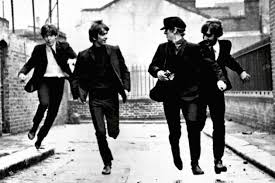 Caproni has
an important line in which he declares that artists have ten years in the sun (referring to glory or good years). THIS IS SO TRUE (and the “ten years” part means a limited amount of
time, usually small). I mean, we’re human, we’re not deities, so it’s natural
that one would produce one success to another…we won’t have enough constant
inspiration for that. And there’ll be a point in which we run out of ideas. Inspiration
doesn’t come when we ask it to. Some examples to which this line can be applied
are the Beatles, who lasted 10 years together, and Bill Waterson, the genius
behind the comic strips Calvin and Hobbes
(practically the most glorious of all comics), who also worked for around ten
years and disappeared from the public face of the world, stating he’d said
everything he had to say. I believe Miyazaki’s own “ten years” lies in the
2000s, between Spirited Away and this
final film, in which he achieved more recognition than ever for his work and a
boom of fans took place, plus I find his artistic peak in his latest works, but
this is just my opinion, it is very debatable.
Caproni has
an important line in which he declares that artists have ten years in the sun (referring to glory or good years). THIS IS SO TRUE (and the “ten years” part means a limited amount of
time, usually small). I mean, we’re human, we’re not deities, so it’s natural
that one would produce one success to another…we won’t have enough constant
inspiration for that. And there’ll be a point in which we run out of ideas. Inspiration
doesn’t come when we ask it to. Some examples to which this line can be applied
are the Beatles, who lasted 10 years together, and Bill Waterson, the genius
behind the comic strips Calvin and Hobbes
(practically the most glorious of all comics), who also worked for around ten
years and disappeared from the public face of the world, stating he’d said
everything he had to say. I believe Miyazaki’s own “ten years” lies in the
2000s, between Spirited Away and this
final film, in which he achieved more recognition than ever for his work and a
boom of fans took place, plus I find his artistic peak in his latest works, but
this is just my opinion, it is very debatable.

Thank you for reading my long rant; I've been wanting to write this for a long time :).